

Animal Intimacies
Dogs & horses & other reasons to live

The year I was first forced to confront the fallibility of my body, I adopted a dog. We were facing our first pandemic winter, and I needed a reason to get out of bed every morning. It was not clear then what was causing the strange revolution in my body, sensations that made me feel like a house with bad wiring—odd vibrations, numbness in my fingers—mild and painless and yet signaling a range of alarming possibilities. Most likely, a trick my body was playing on itself, the result of a defense system gone rogue. That year, when we were still wearing masks in public, wiping down our groceries, keeping our distance, it was especially difficult to understand that a threat could be coming from inside the body, that it was not something I could predict or control or protect myself from.
Once cold truly set in and we were encouraged to only leave the house when strictly necessary, I stayed inside for three days and slumped quickly into a depression. It was clear I could not continue like this for a whole season, and the only solution I could see had four legs and a tail. A dog would require me to do the things that were good for me, like keeping a regular routine, waking up early, leaving the house every day. I was practiced in disregarding my own needs, but I wouldn’t ignore the tender supplications of a scratch at the door, a paw on the leg, a wet nose pushing into my palm. In other words, I knew I would take care of a dog in all the ways I was failing to take care of myself. But the desire also came from a deeper place, nestled in what felt like the very bottom of my heart. It was the need for one of the earliest forms of comfort I can remember—a warm animal body, resting on mine. The feeling was almost primal, like a longing for one’s mother or the longing to be a mother. (A story about me as a child: when I was very small and my parents’ marriage was falling apart, my mother often took me to visit her cousins in the country, where I would inevitably disappear and then be found outside in the kennel with the golden retrievers.)
The narrator in Mare, the debut novel by British writer Emily Hawthorn-Booth (which, full disclosure, was sent to me for advanced endorsement), is also facing a difficult diagnosis and grieving the death of her dog when she finds herself suddenly orientated towards horses. The onset of premature menopause seems to return her to the obsession of her girlhood, and soon her weeks revolve around visits to the stable where she shares a horse with another woman. Reading Mare this month made me think of two other books about the way our bonds with animals can illuminate our human experiences of grief and love: Sigrid Nunez’s The Friend, in which a single woman inherits her best friend’s dog after his suicide, and Brood by Jackie Polzin, which follows a year in the life of a woman attempting to keep a flock of chickens alive after a miscarriage. It sounds simple to say that in each of these books, the animals give these heroines a reason to get out of bed in the morning, but isn’t that the same as saying they give them a reason to live? Even in the depths of grief, dogs need to be walked, chickens need to be fed, a horse needs its stable mucked out and made new. When life starts to feel like a thread rapidly unspooling, these rituals and physical acts of care can give the days a shape and a person a purpose.
I don’t normally read more than one book at a time, but Mare inspired me to pick up Mary Gaitskill’s essay Lost Cat, which was published as a slim standalone volume by Daunt Books and given to me as a Christmas gift from my mother. (I love it when long essays or short stories that get published in book form. Mary Gaitskill has been lucky in this department! See also: This is Pleasure, the only #MeToo book worth reading.) I am not a cat person, but I am a Mary Gaitksill person and reading it has reminded me how much I admire her work. She is one of the rare authors who has the ability to write directly and precisely about intense emotion without being overwrought, or, on the other hand, clinical. Her work is deeply felt, and she writes into experiences of shame and ugliness, but the sentences never buckle under their emotional weight. I’ve heard her work described as cold or even cruel, and this has always struck me as a profound misunderstanding—to me, her ability to clearly see and report our human failings, our ugliness, without judgement is incredibly generous. In any case, Lost Cat shares a resonance with Mare, as I thought it might (aside from the fact that Mary Gaitskill is also a horse person and wrote a novel with the same title.) Both books concern women approaching mid-life, and the pain and beauty of loving what you cannot keep—in Gaitskill’s case, the titular kitten, who goes missing after a move to a new house, a loss that brings into focus her heartbreak over the children she cared for as a foster parent.
In all of these books, it could be tempting to see the animals as substitutes—for the lost friend or the children not-born or not one’s own. But in each case, the beautiful, tactile specificity of each creature, and the details of the care they require, allows them to transcend metaphor. In Mare, the woman returns to her home from the stable with hay stuck to her clothes and inside her nostrils; in The Friend, the narrator takes to carrying a small bucket and spade on her walks to clean up after the Great Dane. Intimacy lives in the grainy particulars of these routines, which make us see these animals as living, breathing things. When writing about animals fails, it is usually because the animal lacks this dimension, acting purely as a symbol on the human’s journey. Instead, these books give these relationships the gravity they deserve, and remind us that there are so many surprising ways to give and receive love in this world. And in times of heartbreak, there is immense solace in love that isn’t mediated by language.
I wonder if part of the intense connection we feel with animals also has to do with the way they bring our own mortality into view, reminding us that we have fallible animal bodies, too, and perhaps allowing us to be more loving and forgiving of them. The great tragedy of dogs is that their lifespan only allows them to walk beside us for a short stretch of our own (especially in the case of large breeds, like the Great Dane in The Friend). Horses can live for up to twenty-five years, but they are vulnerable for animals of such stature. Too much sugar in the water can turn a horse lame, and everyone knows what happens to an injured horse. And though Polzin’s narrator’s cares for them valiantly, the chickens remain hopelessly fragile to foxes and sudden frost.
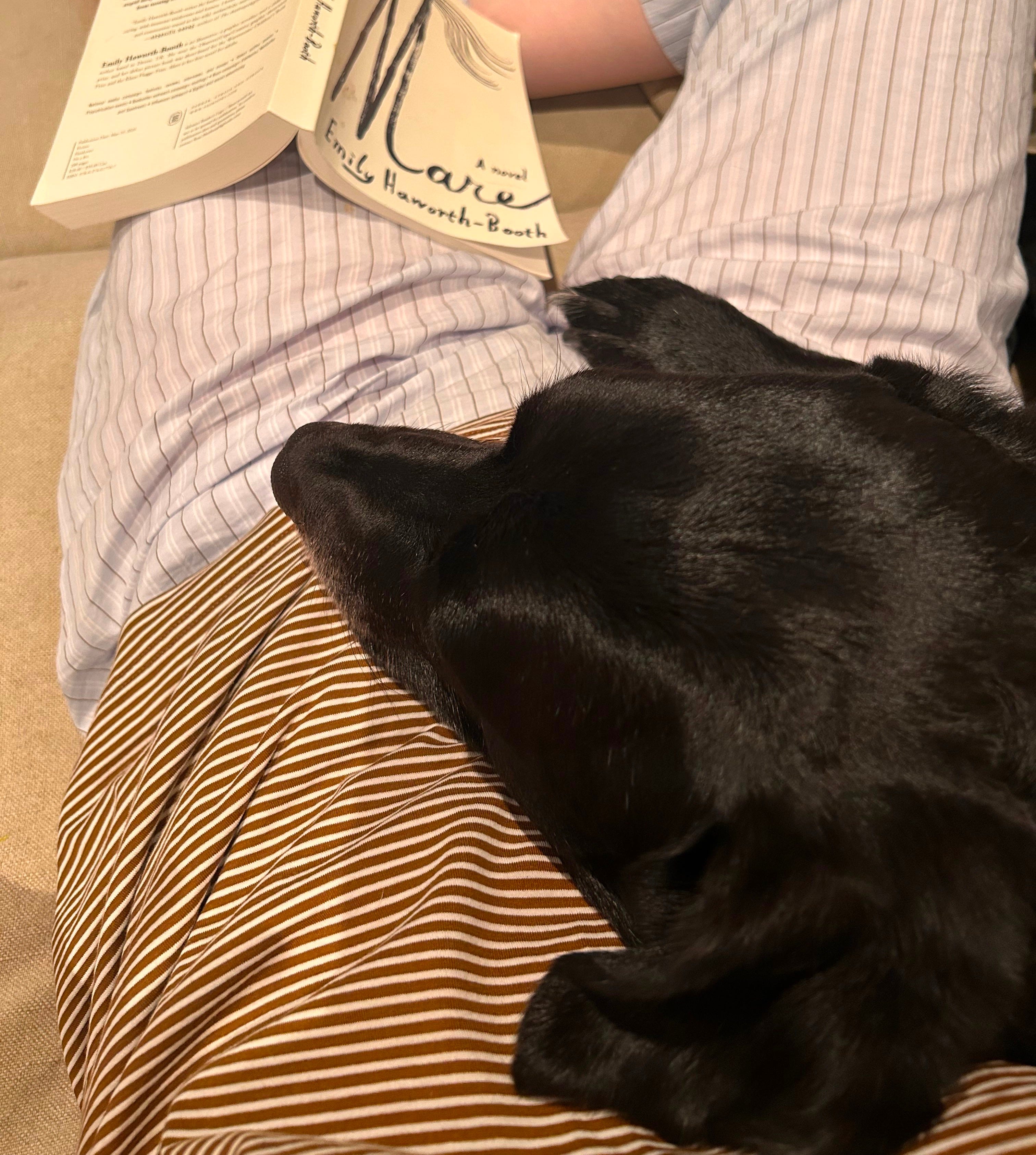
With animals, we can’t deny the difficult truth that there can be no love without the possibility of loss—we enter into this bargain knowing the cost. And yet, that’s what makes these bonds so precious. Our animals remind us that it’s the fragility of life that gives it meaning. So, let us lift our noses to the wind, turn our animal bodies to the sun, and chase the things that make our hearts thrill with abandon while we can. If this is a series about small pleasures, then this is one of the purest ones I know: the dog here beside me while I write, his head on my belly, one paw stretched across my lap like an embrace.
Beautiful letter, Madelaine. Bookmarking the Gaitskill essay. I've not read it yet, but have been told that Caroline Knapp's Pack of Two is a beautiful meditation on the human-animal bond as well. It really is one of the most special things in life, being taught and shown love by animals 🖤
Beautiful. Dogs and horses have so much to teach us. One detail I especially love is that horses can remember us by our heartbeats and rhythm of our breathing 🤍