

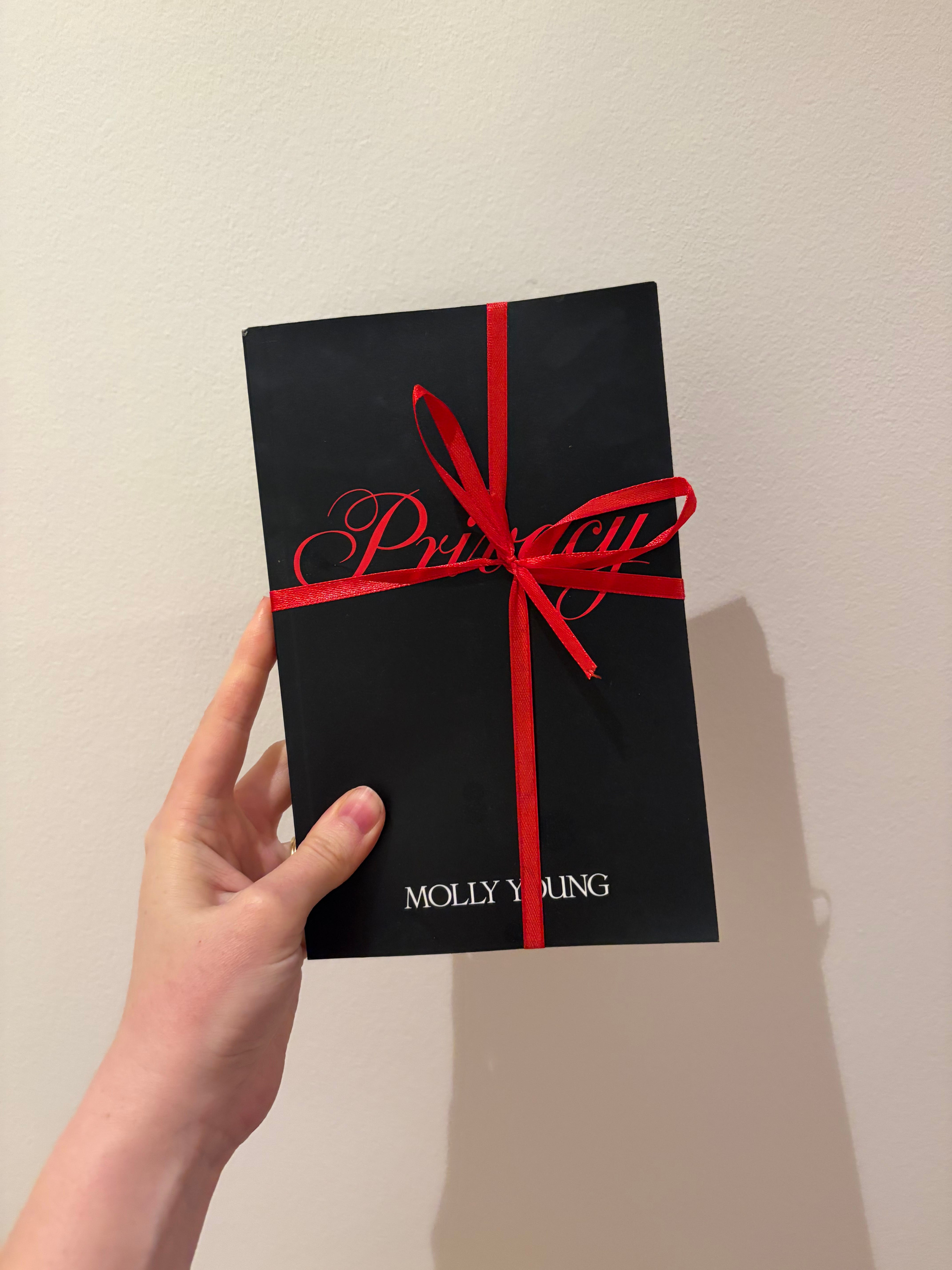
Privacy by Molly Young
Where are all the novels about pregnancy?

This week I read Privacy by Molly Young. I love this as a title for a zine about pregnancy, a condition that complicates the boundaries between intimate and public experiences of the body. (I also love the seductive cover, bound with red ribbon, which recalls both the cheeky sleaze of peep shows and the illicit thrill of opening a 2000s-era teen magazine “sealed section.”) There are the early, secretive weeks before the news is widely shared—whether out of respect for social conventions or one’s own superstitions—but as time goes on and what is happening internally begins to take on a visible and familiar shape, a pregnant person becomes an object of interest. The irony of this transformation, Young writes, is that “Everyone recognizes the form of the pregnant woman except the woman herself, who is constantly catching herself in a reflective surface and thinking: What the fuck.”
There are many ways that the prenatal self becomes unrecognisable—for example, retching at the thought of foods you used to love and eating instead like the world’s fussiest child. Throughout Privacy, Young captures the what the fuck quality of pregnancy with her signature irreverence and charm. She stuffs Warheads into every pocket, “smiling forgetfully at colleagues through blue teeth”, and finds she can only stomach American cheese and mayo sandwiches on white bread. “I sit chewing my bland packets,” she writes, “thinking, I hate this sandwich and yet here I am, eating it.” (Sour candies did little to combat my nausea but I was similarly drawn to beige foods and anything I could reasonably smother in ketchup.) Since reading Young describe the Three Tiers of Fun a few weeks ago, I have become obsessed with this concept and I, personally, would categorize most of pregnancy as Tier Three: Not fun at the time, but funny to describe to someone later. And while Young does find levity in the common trials and humiliations of a healthy gestation, she is also incredibly clear-sighted about the ways these strange-but-ordinary developments can swerve quickly into more frightening and dangerous territory: in her case, a life-threatening postpartum hemorrhage. With so much of pregnancy, every bizarre or uncomfortable symptom is considered “normal” until it is an emergency.
Given that pregnancy is an extremely common and extremely significant human life event, it is striking, as Young notes, that there aren’t many novels that focus specifically on this state. She identifies only one—a “captivating and utterly forgotten” work of fiction from 1938 by Enid Bagnold titled The Squire. (If you’re familiar with Young’s zines or Substack, you’ll know she does her research and her sources are often eclectic and arcane. If she says there are no true pregnancy novels bar this one, I am inclined to believe her.)
Young is not the first one to observe this gap in the literature, and of course, neither was I when, pregnant with my daughter, I discussed the absence of pregnant narrators in fiction with my friend Raegan, something we were both attempting to address in our works-in-progress. As someone who has always looked to novels to clarify and deepen my life experiences, this lack of representation made me feel lonely. While I had spent a good part of my late twenties reading books about motherhood with a mix of curiosity and trepidation, I longed to read a novel about the state of pregnancy while I was inhabiting it the same way I like to read books set in the places I’m visiting on holiday.
It seems especially curious given that a full-term pregnancy has a defined narrative arc familiar to most novelists: a three-part structure, and a clearly delineated beginning and end. And there is perhaps no other life experience, except death, which ends with such a dramatic conclusion as birth. When we have so many novels about illness, grief, war, divorce, coming into adulthood, and many postnatal dramas about motherhood—and even an emerging genre of menopause fiction!—why has this one transformative experience been overlooked?
Young has her theories, and I have mine. When I was pregnant with my daughter, it felt like the most important job I’d ever had—and pregnancy is hard work, both physically demanding and mentally taxing, keeping up with all those appointments, scans, dietary requirements, not to mention my own anxious vigilance. But it culminates in a series of experiences that immediately eclipse everything that came before, including that nine month-long limbo. Birth, new motherhood, the first year of caring for a baby with its rapidly changing phases turns pregnancy into a dim memory.
It seems right then that the most natural form for pregnancy literature has always been the diary, something that captures the present-tense of it all—a history Jazmina Barrera explores in her own pregnancy diary/essay Linea Nigra: On Pregnancy and Earthquakes (translated by Christina McSweeney), which Nichole LeFebvre describes in LARB as “part-memoir, part-commonplace book”.
Perhaps, as Young suggests, those memories of before are simply not as compelling to look back on in comparison to all that comes after. I myself am guilty of this. Now I am pregnant again, I’m not nearly as curious about the transformations taking place inside my body because they are less surprising to me, some of their essential mystery stripped away by repetition. Once the threshold from pre-to-postnatal has been crossed, pregnancy too might be best described as “captivating and utterly forgotten.”
And also congratulations!!!
I haven’t reread it but I think about it often. Afterbirth by Elisa Albert remains to me one of the best books about pregnancy post pregnancy. Eliza Minot also put out a book recently called Orchard but I couldn’t quite get into it. And then there was another book that caused a stir where it was just a lone woman giving birth but I can’t remember the name of it and when I started it I put it back down. There is something so private about birth right. I found there to be so much shame in my unscheduled and unplanned c-section for a while I felt so unwomaned. I’ve mostly gotten over it. However I recently got triggered reading a birth story about breach delivery and found myself thinking about the absolute lack of care and community that surrounds so many births here. This person was able to give birth because she was supported and cared for. Pregnancy, a gap that sure needs filling in the literary world.